Archive for December, 2011

God’s Birthday Celebration
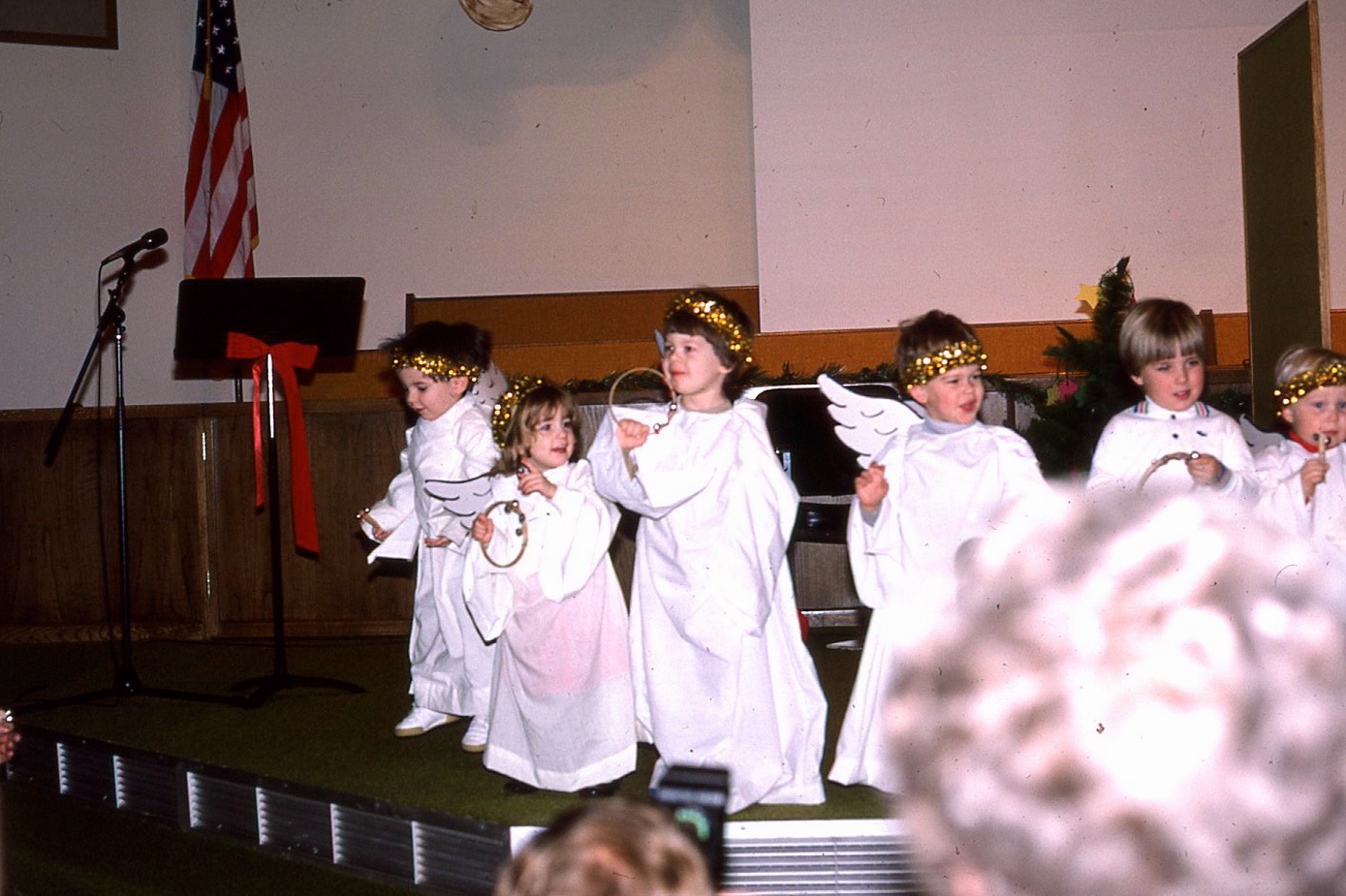
Anticipation of December typically brings memories of the crescendo of events beginning with early celebration of family birthdays (my Grandma’s, my mom’s and my own) and climaxing with Christmas Day.  Lately it is more of a rush of closing out yearend business meetings, eating too much and long checkout lines.  But back in the early 60s life was much simpler.  We didn’t have video games and iPhones.  For recreation, we would play stickball in the street with the sawed off end of a broom.  The 2nd and third steps of the cement staircase leading up to the Serratelli’s house were the strike zone and if you hit it across the street to our house it was a home run.   Or we would have touch football games with the field consisting of three poured sections of concrete in the street.  You got a new set of downs if you got to the crack at the start of the last 3rd of the field.  When it came to Sunday School visual aids, the flannel graph was the primary tool.  Paper cutouts of the Patriarchs or Jesus with felt backing were pressed up on a cloth board and manipulated as the teacher told the story.  The “Davey and Goliath” show was the height of high tech communication.  It is conjured up every time I hear the tune of “A Might Fortress is our God”.

Shortly before Thanksgiving, the plan for the Sunday School Christmas program would be rolled out.  There would be several Saturday mornings of rehearsals prior the main event.  The individual chosen to recite the “welcome” was sure to be either the girl with the softest voice, or the boy with the loudest.  Juvenile speculation would surround the designated actors for Mary and Joseph and the rest of us, as shepherds, wisemen or the heavenly host would have a few lines to be delivered on cue.  The costumes stored in a hallway behind the sanctuary were passed out for the assigned roles, and our moms would either alter or pin them up so we were ready for our dress rehearsal on the final Saturday.
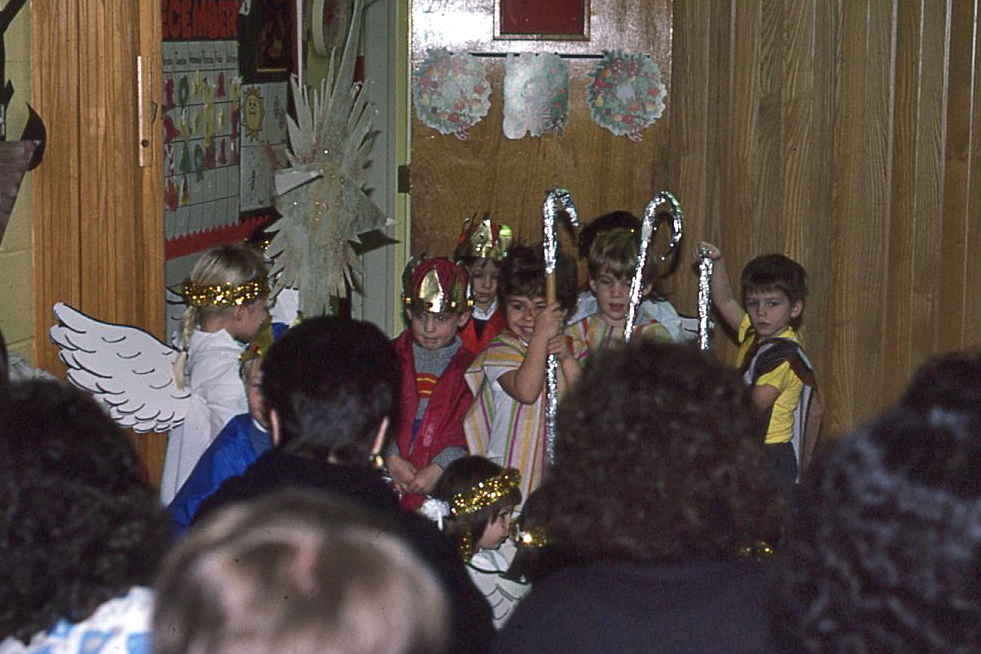
That Sunday night we wouldn’t have to stay dressed up since we had our costumes, and we knew the pastor would not give a sermon, only say a welcome and a prayer over the offering, so we were pretty wired.  Plus we would be getting gifts from our teachers and a full box of chocolate, all our own, from the Sunday School.  (Growing up with 3 siblings there were three times a year that you got candy you could horde as your own: Halloween, Easter and the Christmas program night).  The program itself would have its share of tripped entrances, flubbed lines and every couple of years, a candle would be too close and some girl’s hair would get singed.

This annual event has been repeated in churches around the country not because of the skill of the actors or our taste in family entertainment- it has been repeated because we are celebrating a historical event and engaging in worship.  We are putting on a celebration for God and inviting the audience to celebrate with us.  We are remembering the events of Christ’s birth by reenacting before God, his own miracle.  We are singing to him and for him.

Gradually, during the 80s and 90s, the family video camera intruded on the spectacle to turn the event into a performance on the shelf in the family room.  As we became more discriminating in our tastes we shortened or eliminated the Christmas pageant and were more selective in our musical and theatrical talent, preferring to increase our quality and “relevance”.  Now we can deliver mood, magic and inspiring drama or readings without enlisting the minions of amateurs and wasting shopping days in rehearsals.

I don’t think my church has had a Sunday School Christmas program in at least ten years- and maybe it is silly to think we should go back to that.  But I do want to be able to come together, children, teens, adults, grandparents and celebrate before God for his pleasure.

The Institutionalization of Discipleship

Maybe it is my Baptist roots, maybe it is my naiveté regarding church history or maybe it is a rebelliousness- but it seems that Evangelicals are surrendering to a hierarchical priesthood of professional clergy, paid staff and wisemen rather than diligently taking responsibility for themselves and for one another to encourage, teach, admonish and minister.

Somehow I grew up with the impression that the pastor, church leaders, and teachers were fellow spiritual travellers, maybe more experienced or schooled, but still able to benefit from my youthful spiritual insights and learning as was I from their more seasoned perspective.

When it was testimony time, the floor was open to all.  Prayer meetings were intergenerational (there just weren’t that many of us), and Sunday school was more discussion than lecture.   At summer camp, as a high school counselor, I would either be leading a Bible study of campers or be participating in one with my peers.  The director and senior counselors sat with us in morning devotions as we all shared from the text under review.   In high school and college Bible studies, we would typically rotate responsibility for leading the discussion counting on Holy Spirit’s work within the group to guide our time.

My sometimes selective recollection of Evangelical history brings to mind preachers like DL Moody and Billy Graham who were ready to absorb help from the lay people of the church as quickly as they could be deployed.  Graham’s crusade follow up teams consisted of individuals who were given a training session in how to guide those who came forward and the local churches were enlisted for helping new believers grow in Christ.

Now, it seems that we are less content to subject ourselves to the vagaries of the Holy Spirit working in the body, preferring to vet our leaders through a progression of preparatory steps.  We have discipleship plans that move the participants around a baseball diamond or toward the bull’s-eye on a target as if spiritual growth were assured through so many hours or class sessions.

What did we lose through this?  I think we lost accountability for one another and the ability minister to one another.  We are willing to push responsibility up the chain to the pastor, the elders, the small group leader, the adult.  The hierarchical model not only disempowers the participants but also insulates the leaders.  We become eager to be fed digested truth from above on up the chain rather than doing the hard, patient work of reading, meditation, interaction, and waiting on the Spirit.

One year my son and two friends began a Bible study for high school kids in our home.  My wife, Janet, would meet with them on their preparation and debrief on how it went, but they conducted the study on their own.  It only lasted a season because one of the moms with passion and drive wanted to setup a teen CBS ministry, led by adult discussion leaders and a teaching adult.  It became a bigger ministry, but I’m not sure that it was more conducive to spiritual growth.

Signature Sins

Once again I found myself sitting in the back of the high school Sunday School room biting my tongue as the youth pastor dispensed half-baked ideas regarding spiritual maturity.   The gist of the assessment he was passing on to the group was that they were generally pretty mature and will be able to handle temptation without significant difficulty.  Maybe he was trying to encourage the group that they were on a good path, but my fear was that he was at risk of setting them up for mediocrity in development and confusion regarding their inability to sustain victory in their moral life.

One of the most distinguishing marks I’ve observed in those who I’ve considered more mature in Christ is a healthy sense of humility which does not presume to be beyond the dangers of sin.  What might be interpreted as self-depreciating modesty is really a deep

awareness of their capacity for sin and their daily dependence on Christ’s power and forgiveness.  Christ used a parable of two debtors to illustrate the degree of gratitude for forgiveness of the loan is proportionate to the size of the debt.  By extension, the Pharisees, considering themselves to be good keepers of the law, had less gratitude than the harlot when being extended forgiveness.  The irony is that we would be so foolish as to grade our need of forgiveness relative to each other at all.  It is a loser’s consolation assessed with no ability to see the depth of need.

Michael Mangis wrote a book called “Signature Sins”.  In it he takes the historical Seven Deadly Sins and explores how we often have particular ones which we engage in more than others as part of our “coping structure” to order our world and survive in our own strength.  If you approach this as you would an exercise in discovering your spiritual gifts you might be able to work the formula, identify and cage your demon and elicit sympathy from friends when it raises it’s head.  I found it to be a dark introspection into how the sins to varying degrees have controlled me and defined me and my response to circumstances and people.

The one that is particularly powerful with me is Envy.  My constant tendency has been to evaluate my status relative to others and to desire to be positioned ahead of them- no matter what the metric.   My ability to rejoice with others and even mourn with others has a ball and chain dragging it down – and its name is envy.  If a friend has a new car, I am jealous it is better than mine; if he finds new job after a period of unemployment, I hope he earns less than me; if he is experiencing affliction, I hope mine is greater and if his expression of trust in God is inspiring, I want mine to be more profound.  In measuring happiness I want to experience just a little better, in measuring pain, I want to know mine is greater- whatever the metric is, I want to be further on the scale.  Pretty twisted, huh?

Sometimes we take solace in thinking that we are particularly afflicted like no other before us (except we all pay homage to Job a number 1).  That is a convenient ploy – in allowing God more time to work on us due to our uniquely powerful sin and contributing circumstances, we mask our true desire to feed and find identity in our special victim status.

It was helpful for me to read Thomas a’ Kempis’s, “Imitation of Christ”.  The15th century monk discussed his daily battles with pride, jealousy and other temptations as he lived out his simple monastic life in a way that reminded me that there is no human sanctuary on this earth.  I need to be freed daily from the pull of sin by being reminded of my freedom in Christ, my forgiveness in Christ and his goodness and riches which overwhelm any “good” or “bad” experience or material gain or loss to be had on this earth.  When I live in that reality, I am able to genuinely express joy or sorrow with a brother or sister, without the corruption of envy.  That’s not me in my strength- it is Christ in me.

The Apostle Peter is often seen as the bumbling disciple who overreaches only to be humbled time and again.  Yet I’ve learned to see him more as the one who desires to follow Christ fully, experiences the limitations of human effort and recommits himself to dependence on Christ.  Rather than the youth pastor pumping up the class to move out into their schools and on to college in confidence, I was thinking they would benefit from reflecting on Peter’s adventure out of the boat- He was fine when he fixed his eyes on Christ, but when he ventured to handle it on his own, he quickly sank.  There was no inner faith or strength which he could muster to do it- he needed Christ.

Whether you see a particular sin as “signature” or not isn’t as important as the daily recognition that sin is strong and we will not be successful in our attempts to “manage it”.  With Christ we have both forgiveness and power to overcome sin and replace it with his joy and victory.